 How-to
7 Steps to Choose the Right Home Maintenance Provider
Last Updated: November 16, 2026
Quick Summary
To choose the right home maintenance provider, start by listing your home's actual maintenance needs, then shortlist three or four candidates using service area, required skills, and availability. Verify licenses, insurance, bonding, and background checks before signing, and compare at least three written estimates line by line rather than by bottom-line price.
- Write your needs list in three columns: task, urgency, and whether it is one-time or ongoing.
- Read two- and three-star reviews first, because they describe what went wrong.
- Look up the license number directly on the state or local licensing board's public database.
- Ask whether the service call fee is waived if you approve the work.
- Build a seasonal plan: gutter cleaning in fall, HVAC tune-ups in spring, caulking in summer.
Table of Contents
- Start With Your Home's Actual Maintenance Needs
- How to Shortlist a Home Maintenance Provider
- Verify Licenses, Insurance, and Bonding Before You Sign
- Red Flags When Hiring a Handyman or Maintenance Company
- Questions to Ask a Contractor Before Work Begins
- Understanding Home Maintenance Provider Cost and Quotes
- Building a Home Maintenance Plan That Prevents Surprises
- See Lone Eagle Home Services Plans and Schedule a Walkthrough
- Frequently Asked Questions
Start With Your Home's Actual Maintenance Needs
Choosing the right home maintenance provider starts with knowing what your house actually needs.
Walk your property room by room and note what is aging or overdue: gutters, filters, caulking, the water heater, the roof.
Homeowners often call after a small leak becomes a ceiling repair because nobody was tracking the basics.
Write your list in three columns: task, urgency, and whether it is a one-time fix or ongoing. That single page becomes your filter for every candidate you meet.
How to Shortlist a Home Maintenance Provider
Shortlisting means narrowing a long list of names to three or four serious candidates before you spend time on interviews. Most homeowners skip this step and end up comparing whoever answered the phone first.
Start with a broad pool, then cut it down using three filters: service area, the skills your list requires, and availability. A handyman who is great with drywall may not touch HVAC.
A useful approach is to keep one generalist and one specialist in the running. For a step-by-step process, see our guide on how to find reliable handymen.
Personal Recommendations and Real Estate Agent Referrals
Word of mouth remains the fastest way to find a maintenance provider you can trust. Neighbors, coworkers, and your real estate agent have already tested these people on real property maintenance work.
Ask specifically: did they show up on time, did the price match the estimate, and would you hire them again? Vague praise means little. A specific story about a repair that held up means a lot.
Online Reviews, Reputation, and Background Checks
Online reviews give you volume; they do not give you proof. Read the two- and three-star reviews first, because they tend to describe what went wrong rather than how friendly the technician was.
Look for patterns. One complaint about scheduling is noise. Five complaints about no-shows is a reputation problem.
Background checks matter most when someone will have access to your home while you are at work. Ask directly whether the company runs them on every technician, not just the owner.
Verify Licenses, Insurance, and Bonding Before You Sign
Verification is the step homeowners skip, and it is the one that protects you most. A legitimate home services company will hand over proof without hesitation.
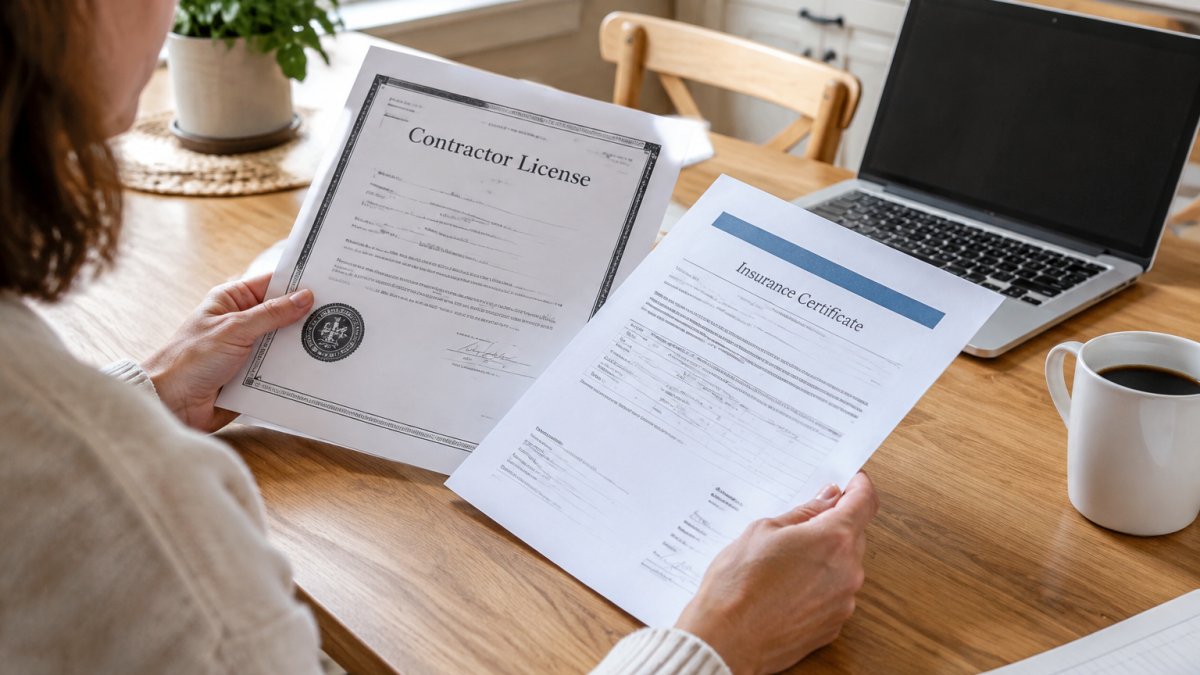
The catch is that "licensed and insured" does not mean the same thing for every task on your list.
Credentials by Task Type
- General maintenance and handyman work: Many states and localities do not require a statewide license for small repairs under a dollar threshold, but they often require business registration, a local permit for certain work, and general liability insurance. Ask for the business registration and a certificate of insurance even when no trade license applies.
- Plumbing: Most states license plumbers through a state board and require permits for work beyond simple fixture swaps. Verify the individual plumber's license number, not just the company's, on the state licensing board's public lookup.
- Electrical: Electrical work is almost always licensed and permitted. Confirm the electrician's license and ask who pulls the permit, a provider who asks you to pull it is shifting liability onto you.
A common pattern is a company that is properly licensed for one trade but subcontracts the rest. That is fine if the subcontractors are licensed and insured too, ask for their certificates as well.
How to Verify Each Document
- License: Look up the license number directly on the state or local licensing board's public database. Confirm the name matches the business, the status is active, and the scope covers your task. A certificate in hand proves nothing if the number is expired or belongs to someone else.
- General liability insurance: Request a certificate of insurance naming the coverage limits and the policy period. Call the insurer's number on the certificate to confirm it is current, certificates can be altered.
- Workers' compensation: Ask for proof of coverage. If the company has no employees, ask whether it uses subcontractors and whether those subcontractors carry their own coverage. An uninsured worker injured on your property can become your problem.
- Bonding: Confirm the bond is current and understand what it covers. A surety bond typically protects you if work is abandoned or the contract is breached, not against poor workmanship.
The U.S. Small Business Administration's guidance on hiring contractors recommends verifying credentials before any work begins. Our guide to what to include in a home maintenance service contract covers the terms worth insisting on.
Watch out: a certificate of insurance that lists only the company, with no workers' compensation coverage, can leave you exposed if a worker is hurt on your property, confirm both before work starts.
Red Flags When Hiring a Handyman or Maintenance Company
The clearest red flags when hiring a handyman are pressure, vagueness, and cash-only demands. Any one of them is a reason to slow down.
Watch for these:
- A large deposit requested before any materials are ordered
- A quote given over the phone without anyone seeing the property
- No written scope of work, just a verbal promise
- No physical address or verifiable business history
Watch out: paying the full job cost upfront can leave homeowners exposed. Tie payments to completed milestones instead.
Reliability shows up early. A provider who is slow to return a call before the job will likely be slower once they have your deposit.
Questions to Ask a Contractor Before Work Begins
The right questions separate a professional from a salesperson. Ask them before signing anything, and write down the answers.
Cover these five areas:
- Who exactly will be on site, and are they background-checked?
- What is the full scope, including materials and cleanup?
- How do you handle a change order if the job grows?
- What is your workmanship guarantee, and for how long?
- Who do I call if something goes wrong after you leave?
For a fuller list, use our questions to ask before hiring a handyman. The answers tell you more about professionalism than any brochure.
Understanding Home Maintenance Provider Cost and Quotes
Home maintenance provider cost depends on scope, materials, access, and whether the work is preventive or emergency. There is no single rate, and any company quoting one over the phone is guessing.
Get at least three written estimates using the same scope. The headline price is the least useful number on the page, what matters is what each quote includes and what it leaves out.
Compare Quotes Line by Line, Not Bottom Line
Ask every provider to break the estimate into the same categories so you can compare like with like:
- Diagnostic or trip fee: Many companies charge a service call fee that may or may not be credited toward the repair. Ask whether it is waived if you approve the work.
- Minimum charge: A one-hour minimum is common, which means a 20-minute fix still bills as an hour.
- Labor rate and estimated hours: Confirm whether the rate is hourly, flat-rate, or per task, and whether the estimate assumes a range of hours.
- Materials: Ask whether materials are marked up, billed at cost, or included. Confirm who buys them and who owns leftover material.
A quote that is 15% lower on the headline but excludes disposal, permits, and a return visit is often the more expensive option.
Build a Total-Cost Picture
Total cost is not the invoice, it is the invoice plus the cost of what happens after. Add these to your comparison:
- Warranty value: A longer workmanship guarantee has real value. Ask what is covered, for how long, and whether it is prorated.
- Expected lifespan: A cheaper repair that fails in a year costs more than a durable one. Ask what the provider expects the repair to last.
- Preventive versus reactive: Emergency and after-hours calls typically carry premium rates. A recurring plan can lower the per-visit cost of routine tasks and reduce emergency calls.
- Downtime: For systems like HVAC or plumbing, days without service have a cost. Ask about response-time commitments.
Service Models and What They Cost
| Service Model | Best For | Cost Pattern | Accountability |
|---|---|---|---|
| Independent handyman | One-off small repairs | Hourly or per job, often with a minimum | Low, varies by person |
| General contractor | Large renovations | Project-based, with draws | Moderate, contract-driven |
| Membership service | Ongoing preventive care | Flat rate or annual fee | High, single point of contact |
A flat-rate model makes budgeting simpler because the price is set before work starts. For real annual benchmarks, our cost of annual home maintenance guide breaks down typical spending.
Watch out: a quote that is dramatically lower than the others usually means something is excluded, ask each provider to confirm in writing what is not included before you compare prices.
Building a Home Maintenance Plan That Prevents Surprises
A home maintenance plan is a written schedule of seasonal and recurring tasks, assigned to a provider and reviewed each year.
Build yours around the seasons: gutter cleaning and roof checks in fall, HVAC tune-ups in spring, caulking and exterior review in summer.
The U.S. Department of Energy's home energy efficiency guidance notes that routine maintenance protects both systems and efficiency.
This is where a membership model earns its place.
See Lone Eagle Home Services Plans and Schedule a Walkthrough
Managing a home should not mean juggling five contractors and a calendar of missed appointments. Lone Eagle Home Services gives Morris County homeowners one trusted team for proactive care, with confirmed appointments and flat-rate pricing.
You get priority scheduling, member-exclusive labor rates, and a digital service report after every visit. If something goes wrong, one point of contact is accountable.
See our plans and schedule a walkthrough to start with a clear picture of your home's needs.
The hardest part of home maintenance is not the repair itself. It is finding someone who shows up, quotes honestly, and stands behind the work.
Frequently Asked Questions
What should I look for when choosing a home maintenance provider?
Look for four things: verified licensing and insurance, a written scope of work for every job, a clear pricing structure, and a track record you can check through references. Ask whether the provider uses employees or subcontractors, since that affects accountability. A home maintenance provider that confirms appointments, sends written reports, and answers questions before you sign is usually the one that answers them after.
What are red flags when hiring a handyman or home maintenance company?
Watch for large cash-only deposits, no written estimate, no proof of insurance, and pressure to decide on the spot. Vague answers about licensing or subcontractors are another warning sign. So is a provider who will not put the scope of work in writing or who quotes a price before seeing the property. Any one of these is reason to slow down; two or more means walk away.
How much does a home maintenance provider cost?
Home maintenance provider cost depends on the service model. Hourly handyman work, per-visit pricing, and membership plans all price differently, and a plan bundles seasonal tune-ups with priority scheduling. Lone Eagle Home Services publishes flat-rate membership pricing on its website, so you can see the monthly figure and what it includes before committing. Compare total annual cost, not just the headline rate.
Is a home maintenance plan worth the cost?
A home maintenance plan pays off when it catches small issues before they become structural repairs. Seasonal tune-ups on HVAC, gutters, and plumbing are designed to catch issues early. The plan is worth it if you want confirmed appointments, one point of contact, and documented service history. If you enjoy coordinating vendors yourself and have the time, per-job pricing may suit you better.