 How-to
Common Causes of Appliance Failure and How to Prevent Them
Quick Summary
Most appliance failure comes from preventable causes, mainly lack of routine maintenance and cleaning. Lint buildup, blocked airflow, and clogged drain hoses cause many breakdowns. The U.S. Fire Administration reports failure to clean caused 31% of home clothes dryer fires from 2018 to 2020.
- Failure to clean was the leading factor in 31% of home clothes dryer fires from 2018 to 2020.
- Check dryer lint traps and vent ducts every few months to restrict fire risk.
- Inspect washer hoses yearly and replace rubber supply lines every five years or sooner if cracked.
- Plug major appliances directly into wall outlets and use surge protectors for electronics.
- Replace an appliance when repair costs exceed half the price of a comparable new unit.
Table of Contents
- Why Appliances Fail Before Their Expected Lifespan
- Lack of Routine Maintenance and Cleaning
- Normal Wear, Age, and Component Breakdown
- Causes of Refrigerator Failure: Cooling, Fans, and Seals
- Electrical Problems, Power Surges, and Appliance Electrical Fire Safety
- Symptom-Based Diagnosis and Repair or Replace Decisions
- Scheduling Your Next Appliance Check With Lone Eagle Home Services
- Frequently Asked Questions
Why Appliances Fail Before Their Expected Lifespan
Last Updated: November 7, 2026
Most appliance failures are not random. A dryer catches fire because lint built up for months. A refrigerator stops cooling because a fan quietly died. A washer floods because a drain hose was never checked.
The U.S. Fire Administration reports that failure to clean was the leading factor contributing to clothes dryer fires in homes, accounting for 31% of cases from 2018 to 2020 (U.S. Fire Administration appliance and electrical fire prevention guidance).
Appliances usually fail for one of five reasons:
- Lack of routine maintenance and cleaning
- Normal wear and age-related component breakdown
- Electrical problems, including power surges
This guide covers each cause, shows how to spot warning signs early, and explains when repair makes more sense than replacement.
Lack of Routine Maintenance and Cleaning
Neglect is the most common cause of avoidable appliance failure. Dirt, lint, and debris restrict airflow and force parts to work harder than they should.
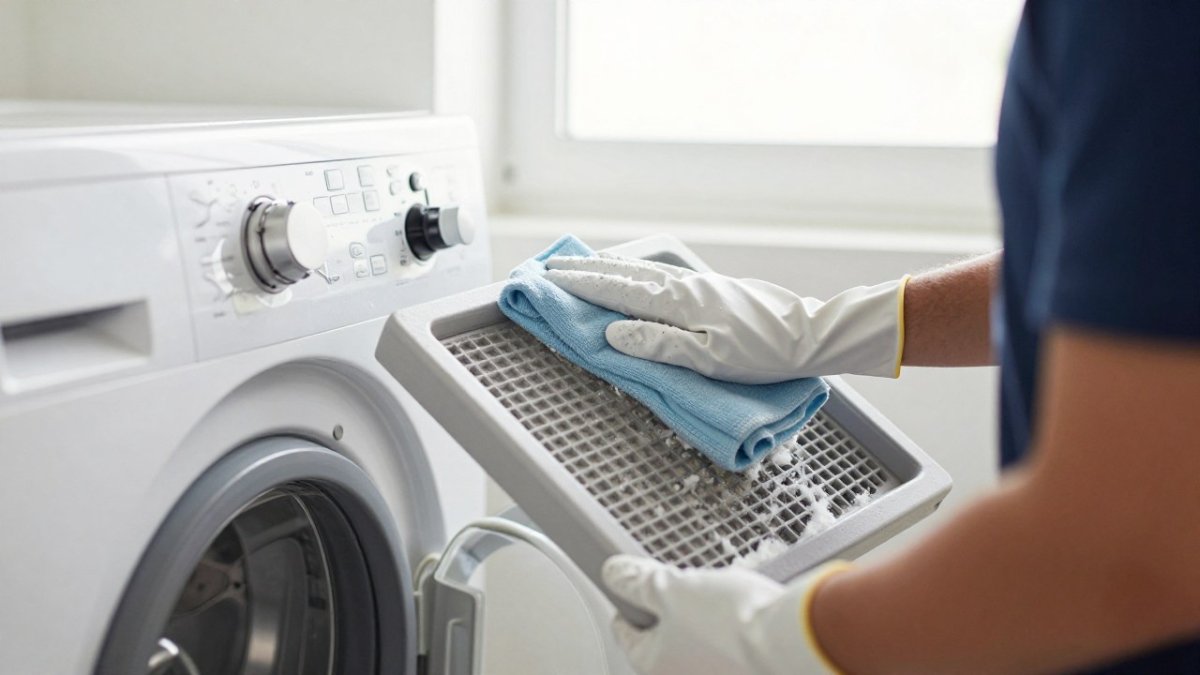
A study of defective washing machines and dishwashers found recurring failure modes tied to electronics, shock absorbers, bearings, and door components (European Commission Joint Research Centre study on household appliance lifetimes and failure modes). Many of these problems start small and grow over time.
Lint, Dust, and Blocked Airflow
Lint is the biggest risk in dryers. It also clogs condenser coils on refrigerators and dehumidifiers.
Check these areas every few months:
- Dryer lint trap, and the vent duct behind the dryer
- Refrigerator condenser coils, usually at the bottom or back
- Air filters on HVAC-connected equipment
- Dishwasher filter, cleaned by hand
Watch out: A dryer vent that feels warm to the touch or smells like burning lint needs immediate attention. Turn the dryer off and have the vent inspected before using it again.
Drainage and Water Supply Problems
Water problems cause leaks, flooding, and poor cleaning. Washers and dishwashers depend on clear drain hoses and steady supply lines.
- Kinked or clogged drain hoses cause slow draining and overflow
- Worn supply hoses can burst under pressure
- Hard water buildup damages heating elements and spray arms
Inspect hoses yearly, and replace rubber supply lines every five years or sooner if they show bulges or cracks.
Normal Wear, Age, and Component Breakdown
Every appliance has a finite service life, and the parts that move, heat, or carry water tend to fail first. Wear is not a single event; it is a sequence. A bearing starts to rumble, the motor draws more current to compensate, the control board sees an odd signal, and a year later the unit stops mid-cycle. Understanding that sequence helps you separate a cheap fix from a death sentence.
Which Components Fail First, and Why
- Motors and bearings: Constant rotation wears down lubricant and bearing surfaces. The first symptom is usually noise, not failure to run.
- Fans: Evaporator and condenser fans run almost continuously. Dust on the blades unbalances them, and the bearing wears faster.
- Thermostats and thermistors: Heat cycling cracks solder joints and drifts calibration, so temperatures stop holding.
- Control boards: These fail from heat, moisture, and voltage spikes more often than from old age alone. A board that fails at year four usually points to a power-quality or ventilation problem, not normal wear.
Typical Service Life, Treated as a Range
Typical service life estimates vary, and installation, water quality, and load habits can move a unit up or down by several years:
- Refrigerators: roughly 10 to 15 years
- Clothes washers: roughly 10 years
- Clothes dryers: roughly 10 to 13 years
- Dishwashers: roughly 9 to 12 years
Treat these as planning numbers, not warranties. A well-ventilated refrigerator with clean coils routinely outlasts a poorly installed one by years, and a washer in a hard-water household may need a heating element or inlet valve well before the range above.
Reading the Age Signals
- Louder operation, grinding, or squealing that worsens over weeks
- Cycle times that stretch without a change in settings
- Visible rust, corrosion, or water staining around seams and fittings
- The same component repaired twice in two years
Age alone does not justify replacement. A 12-year-old refrigerator with a failed door gasket is a cheap repair; the same unit with a failed sealed compressor is usually not.
Watch out: A unit that trips a breaker, smells like burning insulation, or leaks water near electrical components has moved past normal wear into a safety problem. Stop using it and have it evaluated before spending money on parts.
Causes of Refrigerator Failure: Cooling, Fans, and Seals
Refrigerators fail in predictable ways. Most problems involve cooling, airflow, or the door seal.
- Evaporator fan failure: Food may freeze in the back while the fridge runs warm
- Condenser fan failure: The compressor overheats and may shut off
- Compressor problems: The fridge runs constantly but does not cool well
- Door gasket wear: Warm air leaks in, forcing the compressor to run longer
Quick check: Put a thermometer in a glass of water inside the fridge. It should read 37°F. Keep the freezer at 0°F (the FDA).
Clean condenser coils, check the door seal with a dollar bill test, and confirm the temperature settings before calling for service.
Electrical Problems, Power Surges, and Appliance Electrical Fire Safety
Electrical faults cause some of the most serious appliance failures. Power surges can damage control boards and motors. Loose connections create heat that can start fires.
A few safety basics:
- Plug major appliances directly into wall outlets, not extension cords
- Use surge protectors for electronics, including refrigerators with control boards
- Never run a dryer on a damaged or overheating outlet
If a breaker trips repeatedly, an outlet feels hot, or a cord looks scorched, stop using the appliance. Call a licensed electrician rather than attempting repairs yourself.
Symptom-Based Diagnosis and Repair or Replace Decisions
Most guides hand you a list of faults. A faster approach is to start from what the appliance is doing and work toward the cause in a fixed order, so you do not chase the wrong part. The workflow below is deliberately conservative: it keeps you away from electrical and water hazards until you have ruled out the simple causes.
Step 1: Make the Area Safe Before You Touch Anything
- Unplug the appliance, or shut off the dedicated breaker for hardwired units, before removing panels or reaching behind it.
- Close the water-supply valves before disconnecting or inspecting hoses on washers, dishwashers, and refrigerators with ice makers.
- Let a dryer cool completely before pulling it away from the wall; lint and heat together are the fire risk.
- Do not open the sealed refrigeration system, the burner compartment of a gas range, or any control board enclosure. Those are licensed-technician work.
Watch out: If you see scorched wiring, smell burning plastic, feel a hot outlet, or find standing water near a cord or connection, stop. Do not reset the breaker and try again. Call a licensed electrician or appliance technician.
Step 2: Match the Symptom to the Likely System
| Symptom | Likely system | Safe first check |
|---|---|---|
| Will not start at all | Power supply or door/lid switch | Confirm outlet power, check the door switch, check the breaker |
| Trips the breaker | Electrical fault or motor drawing high current | Stop use; do not reset repeatedly; call an electrician |
| Washer will not drain | Drain hose, pump filter, or lid switch | Clean the pump filter, straighten the hose, check the lid switch |
| Washer leaks | Supply hose, drain hose, or door boot | Shut off water, inspect hoses and the door boot for cracks |
| Dryer takes multiple cycles | Airflow restriction | Clean the lint trap, then the vent duct and the outdoor hood |
| Dryer will not heat | Thermal fuse, heating element, or vent blockage | Check the vent first; a blocked vent can blow the thermal fuse |
| Refrigerator warm, freezer cold | Evaporator fan or defrost system | Listen for the fan, check for frost pattern on the rear panel |
| Refrigerator warm throughout | Condenser coils, condenser fan, or compressor | Clean the coils, confirm the fan runs, check the door seal |
| Dishwasher leaves residue | Filter, spray arms, or water temperature | Clean the filter, clear spray-arm holes, confirm the water heater setting |
| Dishwasher will not drain | Drain hose, air gap, or disposal connection | Check the air gap and the disposal knockout plug |
| Oven will not heat evenly | Heating element, temperature sensor, or door seal | Check the seal and the sensor; elements are a technician job on gas units |
Step 3: Rule Out the Cheap Causes First
Before buying a part, confirm the boring explanations: the unit is plugged in, the breaker is on, the door or lid is fully latched, the filter is clean, the vent is clear, and the water valves are open. A large share of service calls end here, and none of these checks require tools.
Step 4: Decide Repair or Replace With Numbers, Not Guilt
A common rule of thumb is the 50% guideline: if the repair estimate exceeds half the price of a comparable new unit, replacement usually wins. Add two more tests:
- Remaining life: Subtract the appliance's age from the midpoint of its typical service life. If the repair buys only a year or two, replacement is usually the better spend.
- Repeat failure: Two repairs of the same component within two years signals a deeper problem, not bad luck.
Also weigh efficiency. A failed 15-year-old refrigerator may cost more to repair than the energy savings from a current model justify keeping it. Check the warranty before authorizing any repair; a covered part changes the math entirely.
Watch out: A repair quote that arrives before any diagnostic step is worth questioning. Ask what was tested and which readings support the diagnosis.
Scheduling Your Next Appliance Check With Lone Eagle Home Services
Many of the problems in this guide can be caught early with a simple check. You can book a professional appliance check or explore our fixture and appliance installation services if you are upgrading.
If you are deciding between repair and replacement, our repair versus replace cost guide walks through the numbers. For electrical concerns, read our electrical wiring failure warning signs before the next storm season.
Lone Eagle Home Services provides confirmed appointments and digital service reports after every visit. Get started with a membership plan and keep your appliances running longer, with fewer surprises and no juggling multiple contractors.
Frequently Asked Questions
What appliance breaks down the most?
Refrigerators, washing machines, and clothes dryers are among the appliances that most often need repair, largely because they run constantly or cycle through heavy loads. Their common failure points include door seals, fans, drain pumps, heating elements, and control boards. Keeping coils clean, checking seals, and clearing lint and drain filters on a regular schedule catches many of these problems before they leave you without a working appliance.
Can power surges cause appliances to fail?
Yes. Power surges and voltage fluctuations can damage control boards, motors, and other electronic components, especially in modern appliances that rely on circuit boards. A whole-home surge protector or a protected outlet for sensitive appliances reduces this risk. If you notice flickering lights, a tripping breaker, or an appliance that stops responding after a storm, have a licensed electrician inspect the circuit before running the appliance again.
Is it better to repair or replace a broken appliance?
A common guideline is the 50 percent rule: if the repair costs more than half the price of a comparable new appliance, replacement is usually the better choice. Age also matters. An older unit with a failing compressor or sealed-system problem often isn't worth fixing, while a newer appliance with a single failed part, such as a door gasket or fan motor, usually is. Compare the repair quote against current replacement prices before deciding.
What is the most common cause of refrigerator failure?
Refrigerator problems often trace to dirty condenser coils, a failing evaporator or condenser fan, a worn door gasket, or a thermostat that is set incorrectly. Dirty coils make the compressor work harder and can lead to overheating. Checking the coils twice a year and confirming that the door seals tightly are simple steps that prevent many cooling problems.