 How-to
9 Kitchen Flooring Replacement Costs in NJ You Need to Know
Last Updated: November 16, 2026
Quick Summary
Kitchen flooring replacement in NJ costs about $5 to $12 per square foot installed for luxury vinyl plank, $4 to $9 for laminate, $9 to $18 for engineered hardwood, and $4 to $10 for ceramic tile. Removal of the old floor adds $1.50 to $3.50 per square foot, and subfloor repairs or disposal can raise the total.
- Labor typically runs 40 to 60 percent of the total installed price and trends higher in New Jersey.
- Tile removal costs $2.50 to $3.50 per square foot because thinset must be chipped off.
- Add 10 percent for waste when using an online flooring calculator for your kitchen.
- A 150-square-foot standard kitchen has a realistic total range of $1,425 to $4,125.
- Homes built before the 1980s should have flooring samples tested for asbestos before demolition.
Table of Contents
- Kitchen Flooring Replacement Cost in NJ per Square Foot
- Installed Cost by Flooring Material: LVP, Laminate, Tile, and Hardwood
- Average Cost of Flooring Removal and Installation
- Labor Cost to Replace Flooring in a New Jersey Kitchen
- Using a Kitchen Flooring Replacement Cost in NJ Calculator
- What Contractors Leave Out: Subfloor Repairs, Disposal, and Site Access
- How to Compare Flooring Quotes and Choose Your Next Step
- Frequently Asked Questions
Kitchen Flooring Replacement Cost in NJ per Square Foot
Kitchen flooring replacement cost in NJ runs about $5 to $12 per square foot installed for luxury vinyl plank, $4 to $9 for laminate, $9 to $18 for engineered hardwood, and $4 to $10 for ceramic tile, according to Realty Improvement's New Jersey flooring cost guide. That per-square-foot number is where every honest budget starts, and it is also where most homeowners stop asking questions too early.
The installed rate is only part of the total. Removal of the old floor, subfloor repairs, and cabinet toe-kick work can all add to the final cost of a kitchen floor replacement. Below, we break down what each material actually costs installed, what contractors leave out of the first quote, and how to compare bids without getting burned.
Installed Cost by Flooring Material: LVP, Laminate, Tile, and Hardwood
The installed price is material plus labor plus the prep work your specific kitchen needs. Nationally, professional flooring installation lands between $1,528 and $4,849 depending on room size, material, and local labor rates, per Angi's 2026 flooring cost data. New Jersey sits at the higher end of most of those ranges.
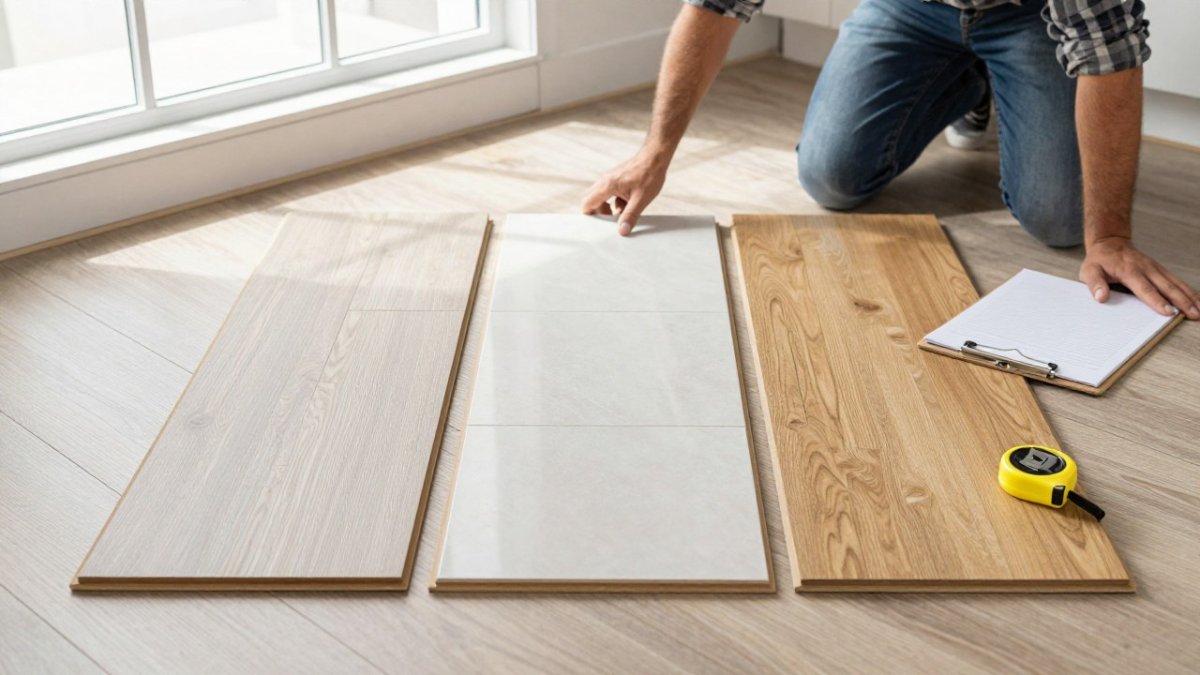
Here is how the four common kitchen choices stack up:
| Material | Installed Cost per Sq. Ft. | Best For | Watch Out For |
|---|---|---|---|
| Luxury vinyl plank | $5-$12 | Busy kitchens, moisture, budget | Subfloor must be flat |
| Laminate | $4-$9 | Fast installs, rental turnover | Water damage at seams |
| Ceramic tile | $4-$10 | Heavy traffic, wet zones | Cracked grout, hard on feet |
| Engineered hardwood | $9-$18 | Warm look, resale value | Moisture and humidity swings |
Installed Cost per Sq. Ft.
A New Jersey kitchen renovation guide puts installed hardwood or engineered wood at $10 to $20 per square foot, per Hello Chapter's New Jersey kitchen renovation cost guide, which reflects the premium end of the market. Tile is the wildcard. A 200-square-foot kitchen example shows $800 to $2,000 for tile flooring, per IA Home Improvement's New Jersey kitchen remodeling cost data, but that excludes pattern layouts, which add labor fast.
Average Cost of Flooring Removal and Installation
Removing the old floor costs $1.50 to $3.50 per square foot, per Angi's flooring removal estimates. That line item is the one homeowners forget, and it is the one that turns a $1,200 estimate into a $1,800 invoice. But the range is wide because removal is not one job. What is coming out, how it was fastened, and how many layers sit on the subfloor all change the labor hours and the disposal bill.
Here is how removal breaks down by existing floor type in a kitchen:
| Existing Floor | Typical Removal Cost per Sq. Ft. | What Drives the Number |
|---|---|---|
| Vinyl or laminate | $1.50-$2.50 | Glue or floating edges; usually fast |
| Carpet (rare in kitchens) | $1.00-$2.00 | Tack strips and staples |
| Ceramic or porcelain tile | $2.50-$3.50 | Thinset chipping, dust control, possible subfloor damage |
| Hardwood or engineered wood | $2.00-$3.50 | Nails, staples, and adhesive |
| Multiple layers | Add $1.00-$2.00 per layer | Each layer adds time and debris volume |
Tile is the slow one. Thinset bonds to the subfloor, so the crew has to chip it off with a hammer drill or chisel, and that work can scar the subfloor underneath. A common pattern is a tile removal that exposes a soft or delaminated layer of plywood, which then has to be repaired before new flooring goes down.
Disposal is a separate line. Old flooring is heavy and bulky, and many municipal waste programs do not take construction debris in curbside pickup. Contractors typically charge a haul-away fee or rent a dumpster, and the cost depends on volume and weight. Tile and hardwood generate far more weight than vinyl or laminate. Ask whether the bid includes the dumpster, the haul-away, and any landfill tipping fees, or whether those appear later as extras.
Older kitchens deserve a planning note. Older homes may contain materials such as asbestos or lead in flooring and adhesives, so if your home was built before the 1980s, consider having a sample tested by a qualified professional before demolition begins.
Installation itself is the straightforward part. The variables are underlayment, floor prep, and how much furniture and appliance moving the job requires. A kitchen is not an empty bedroom. Contractors charge for the extra care, and the removal line is where a low bid most often hides its missing scope.
Labor Cost to Replace Flooring in a New Jersey Kitchen
Labor typically runs 40 to 60 percent of the total installed price, and in New Jersey it trends higher than the national average because of local wage rates and permit requirements. A vinyl plank or laminate installation starts around $5 per square foot in labor alone, with materials extra, per AB Contracting & Design's New Jersey flooring cost guide.
What drives labor up in a kitchen specifically:
- Cabinets and appliances in place. Toe-kicks need cutting, and the dishwasher and range usually have to come out and go back.
- Room shape. An L-shaped kitchen with an island means more cuts and more waste than a simple rectangle.
- Subfloor condition. A soft spot or an uneven joist adds hours.
- Pattern layouts. Herringbone and diagonal tile take longer than a straight grid.
If you are weighing a handyman against a flooring specialist, know what each typically handles. A straightforward plank install may suit a handyman, while tile, subfloor repair, or moisture-related work usually calls for a specialist. Our guide on what to look for when hiring a handyman for home repairs covers the questions to ask before you hand over a deposit.
Using a Kitchen Flooring Replacement Cost in NJ Calculator
An online flooring calculator gives you a rough number in about two minutes. It multiplies your square footage by a per-square-foot rate. That is useful for a sanity check, not for a budget.
Here is how to use one honestly:
- Measure the actual kitchen floor, not the whole room. Subtract the island footprint and the cabinet bases.
- Add 10 percent for waste. Cuts, mistakes, and future repairs eat material.
- Enter the installed rate, not the material rate. The material price at the store is roughly half the installed cost.
- Add removal and disposal separately. Most calculators skip it.
- Compare the result to two real quotes. If a bid comes in 40 percent below the calculator, ask what is missing.
The calculator cannot see your subfloor, your cabinet layout, or whether the old tile is bonded to a concrete slab. Those are the details that move the final number.
What Contractors Leave Out: Subfloor Repairs, Disposal, and Site Access
The gap between a low bid and a real one usually lives in three places. Ask about each before you sign.
Subfloor repairs. A soft spot near the sink or dishwasher often means water damage. Repair can add hundreds to the job, and it is rarely in the first quote. If the contractor will not pull a floor register or press on the subfloor during the estimate, that is a warning sign.
Disposal. Hauling old flooring away costs money. Some bids include it, some add it later. Get it in writing.
Site access. Stairs, tight hallways, and a kitchen full of furniture slow the crew down. Contractors who quote without seeing the path from the truck to the kitchen are guessing.
When extras appear mid-job, you need a paper trail. Our guide on contractor accountability for home repairs explains how contracts, photos, and written change orders protect you.
How to Compare Flooring Quotes and Choose Your Next Step
Quotes on the same kitchen can differ, and a much lower bid may be missing scope. The way to catch that is to compare bids line by line against a kitchen-specific checklist, not against the bottom-line number.
Use the checklist below to compare bids on equal footing.
| Kitchen Floor Size | Material Only | Labor | Removal and Disposal | Prep Allowance | Realistic Total Range |
|---|---|---|---|---|---|
| 100 sq. ft. (galley) | $300-$900 | $500-$1,000 | $150-$350 | $0-$500 | $950-$2,750 |
| 150 sq. ft. (standard) | $450-$1,350 | $750-$1,500 | $225-$525 | $0-$750 | $1,425-$4,125 |
| 200 sq. ft. (large with island) | $600-$1,800 | $1,000-$2,000 | $300-$700 | $0-$1,000 | $1,900-$5,500 |
Those ranges assume the cabinets and appliances stay in place. That is the normal kitchen scenario, and it is also where quotes diverge most. A crew working around fixed cabinets has to cut toe-kicks, work under the dishwasher and range, and fit flooring around cabinet bases and an island. Some contractors remove and reset the appliances; some ask you to empty and move them. Some cut the toe-kick and some leave the flooring butted to it.
Use this checklist to compare bids on equal footing:
- Material brand, grade, and thickness, not just "vinyl plank" or "tile."
- Waste factor, typically 10 percent, stated as a line item.
- Removal and disposal, listed separately with the dumpster or haul-away included.
- Subfloor prep allowance, even if it is a placeholder, with a stated hourly or per-square-foot rate for repairs found mid-job.
- Underlayment and moisture barrier, named by product.
- Transitions and trim, including thresholds at doorways and any shoe molding or quarter round.
- Appliance and cabinet handling, spelled out: who moves the range and dishwasher, and whether toe-kicks are cut.
- Labor rate and crew size, so you can sanity-check the hours.
- Timeline and payment schedule, with a holdback until punch-list completion.
- Warranty coverage, separated into material warranty and labor warranty.
Watch out: a quote that lists a single lump sum with no breakdown gives you nothing to compare and no protection if the job grows. Ask for itemization before you sign, and ask each contractor to confirm in writing whether permits are required for your scope. Most cosmetic flooring swaps do not require a permit, but structural subfloor repair or work that touches plumbing or electrical may, and the answer should come from your local building department, not from the bidder.
Labor rates and access conditions can differ across the state, so ask each bidder how their pricing reflects local conditions. A third-floor walk-up, a tight driveway, or a kitchen packed with furniture all slow the crew and can show up as a site-access charge. Ask each bidder how they priced access, and compare like with like.
Before you hire anyone, read our guide on how to avoid contractor price gouging and our guide to finding reliable home contractors. For the bigger picture on what a full kitchen project costs, see our New Jersey kitchen remodeling cost breakdown.
Frequently Asked Questions
What is the typical cost of replacing kitchen flooring in NJ?
Installed flooring prices vary by material, and the total depends on room size and the condition of the subfloor. Always confirm what a quote includes, since some installed prices exclude tear-out and preparation.
How much does flooring removal and installation add to the project?
Removal is a separate cost that can rise for tile set in mortar or flooring installed over adhesive. Ask your contractor whether the removal line item includes hauling the old flooring away and dump fees.
How much does labor cost to replace flooring in a kitchen?
Labor is typically the largest single line on a kitchen flooring quote. Labor is often billed separately from materials, so ask for the two to be quoted as separate numbers. Tile and hardwood take longer to set, so labor for those materials runs higher. Get the labor rate and the material allowance quoted as separate numbers so you can compare bids fairly.
Is it cheaper to install kitchen flooring yourself or hire a professional?
DIY saves the labor line but rarely the full difference. Kitchen floors need flat, dry subfloor, precise cuts around cabinets and appliances, and correct transitions at doorways. Mistakes with moisture barriers or leveling show up within a season as lifting planks or cracked grout. For most Morris County homeowners, the labor premium buys speed and accountability.